

Support status changes what an engagement should cost and what it should prioritise. Two of the six tracked lines left regular support this month.
You are current, so any organic problem is architectural rather than patch-level. That usually points at catalogue structure, layered navigation configuration, or something a migration left behind.
GA 12 May 2026 Supported into 2029 PHP 8.5
Version status is not your problem, so the conversation moves to what the store is doing. How many filtered URLs are crawlable, whether canonical logic survived your last theme update, and what product pages score on mobile.
PHP 8.4 MariaDB 11.4 Common target from 2.4.6
You are inside the window with time to plan. This is the cheapest possible moment to do the groundwork, because fixing URL structure and faceted crawl rules before an upgrade costs a fraction of repairing them afterwards.
Patched under current bulletins Best moment to audit
On Magento Open Source that date was a hard stop with no further patches. Adobe Commerce customers receive an extended window at no additional cost, then a security-only period.
Open Source · no extension Adobe Commerce · to Aug 2027 Target · 2.4.8 or 2.4.9
Same hard stop, longer road ahead. The SEO risk is not the unpatched code. It is the upgrade, because version jumps rewrite URL keys, reset canonical logic and break redirect chains.
Open Source · no extension Two version jumps Plan 6 to 12 weeks
Magento 1 reached end of life in June 2020 and the early 2.x lines followed. These stores need a migration plan rather than a maintenance plan.
No patches from any source Migration, not maintenance
| Release | Status | Regular support ends | Adobe Commerce extension |
|---|---|---|---|
| 2.4.9 | Current | 2029 | Not required |
| 2.4.8 | Supported | 2028 | Not required |
| 2.4.7 | Ageing | 2027 | Available |
| 2.4.6 | Ended | 11 Aug 2026 | To Aug 2027 |
| 2.4.5 | Ended | 11 Aug 2026 | Expired |
| 2.4.4 and older | End of life | Passed | None |
Support status tells you the deadline. It does not tell you what is costing you organic revenue right now.
Get the Free Audit →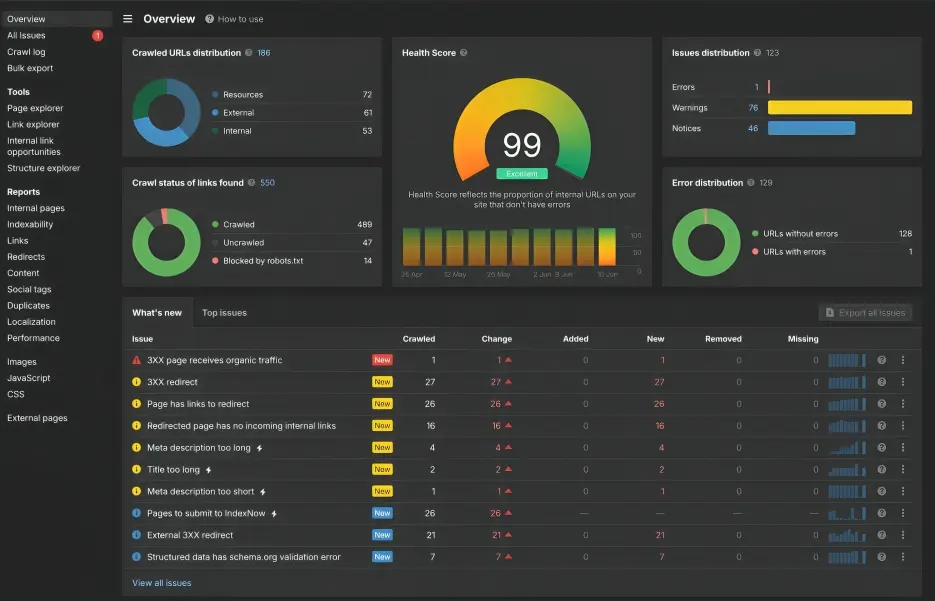
Magento Open Source and Adobe Commerce share a codebase, so they share most SEO problems. Where they diverge is support and tooling, and that difference changes what an engagement should cost.
Every engagement starts with the audit. We do not sell a retainer to a store we have not diagnosed.
From $2,400 · 2 weeks
From $9,000
Scoped per engagement
Speed optimization, international SEO, and consulting retainers open when we are staffed for them. We would rather say that than sell a service we cannot deliver well.
Every rate is on the site with the assumptions behind it. No discovery call required to find out whether you can afford us.
Real stores taken apart with real data. Every figure reproducible, every method published, every finding dated.
You work with the consultant who runs the audit. No account layer, no junior handoff, no rotating team.
We sell no extensions and take no vendor commissions, so the answer never has to end in a purchase.
Three live stores, taken apart in public. Every figure is reproducible and every method is published.
Layered navigation generated four times more crawlable URLs than the catalogue contained.
Two regional storefronts were invisible in their own markets after a theme update.
812 redirect chains, three hops deep
A 2.4.4 to 2.4.7 upgrade rewrote URL keys without collapsing the old chains.
Two regional storefronts were invisible in their own markets after a theme update.

Adobe Certified Professional. Previously technical SEO lead at [Company].
Byline and date on every page. Rewritten, not quietly refreshed, when advice changes.
Crawler, settings, sample size and date included so any finding can be reproduced.
We sell no extensions, so no recommendation has to end in a purchase.
Catalogue size, store view count, edition and current technical state move these numbers. Nothing else does.
| Engagement | Range | Timeline | Best fit |
|---|---|---|---|
| Technical audit | $2,400 – $6,000 | 2–3 weeks | Any store, any edition. Start here. |
| Migration project | $9,000 – $28,000 | 6–16 weeks | Upgrade, replatform or exit. |
| Ongoing retainer | $4,500 – $12,000/mo | Rolling, 30 days notice | Stores with in-house developers to direct. |
How To Choose
Three kinds of business bid for Magento SEO work and they are not interchangeable. We are column one, and the table is more useful to you if you read it knowing that.
| Specialist | Extension vendor | Generalist agency | |
|---|---|---|---|
| Optimises for | Your organic revenue | Module installs and renewals | Retainer breadth across clients |
| Who writes the fix | The person who found it | A documentation page | A junior on four other accounts |
| Conflict of interest | None on tooling | Every answer ends in a purchase | Platform-agnostic by necessity |
| Platform depth | Magento only | Deep in one module | Whatever the client runs |
| Cannot fix | Bad product data, bad pricing | Anything outside the module | Catalogue and template architecture |
How We Work
Free Audit
Audits run $2,400 to $6,000 depending on catalogue size and store view count. Migration projects run $9,000 to $28,000. Retainers start at $4,500 a month. Those numbers sit on the pricing page with the assumptions behind them, because a quote you cannot sanity-check is not a quote.
Not directly, and then very much indirectly. Unpatched stores accumulate vulnerabilities, and card-skimming compromises on Magento have historically produced malware flags and manual actions. The larger risk is the upgrade itself. Version jumps rewrite URL keys, reset canonical logic and break redirect chains. That is where rankings actually get lost.
For some stores, no. If your catalogue is simple, you have no B2B requirement, and you are carrying a five-figure annual infrastructure bill to run it, another platform will serve you better and we will tell you so. Magento earns its overhead on large catalogues, multi-store operations and complex B2B. If that is not you, we would rather say it now than bill you for two years.
An extension sets canonical rules, generates meta patterns and manages redirects. It cannot decide which filter combinations deserve indexing, restructure a category tree around real demand, or tell you your last migration left 800 chained redirects behind. Tools execute decisions. They do not make them.
Indexation and crawl changes usually show within four to eight weeks. Category and product ranking movement typically takes three to six months. Anyone promising faster on a platform this size is describing luck rather than a method.
Yes. Cloud changes deployment and caching behaviour, which changes how we test. Adobe Commerce as a Cloud Service moves the core out of your reach entirely and pushes the storefront toward Edge Delivery Services, which raises its own question about what ships in the first HTML response.
We will run the exit. Preserving organic revenue through a replatform is the same discipline as any other migration, and knowing the platform you are leaving is most of the work. We would rather do that job properly than talk you into staying on a platform that no longer fits.
Our Blog
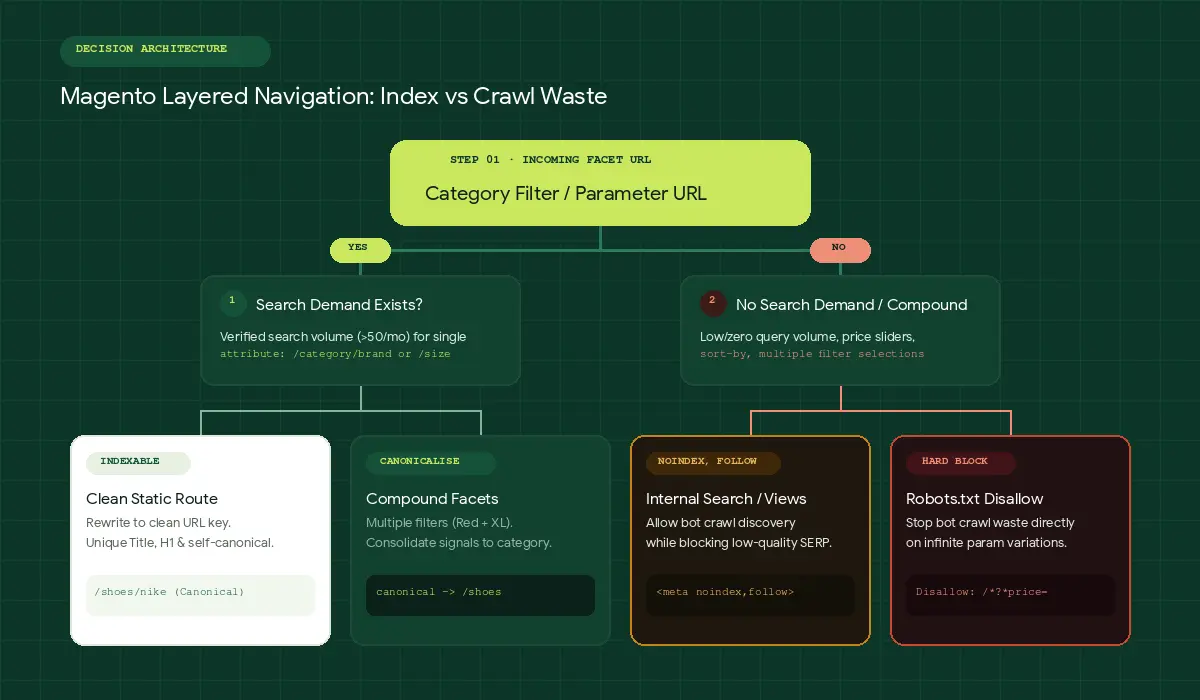
Which filter combinations deserve indexing, which belong in robots.txt, and why the advice most Magento articles still repeat was retired by Google years ago.
A prioritised technical diagnosis, written for developers, delivered in two weeks. No call required to receive it.